Glacier Bear (Blue Bear):
A rare, bluish-gray color phase found in parts of Alaska.
Kermode Bear (Spirit Bear): A subspecies (Ursus
americanus kermodei) found in coastal British Columbia.
About 10–20% of this
subspecies are white due to a recessive gene, but they are genetically American Black Bears.
3. The Brown Bear (A Species with Subspecies)
Scientific Name:
Ursus arctos
Color/Appearance: Varies widely from near-white or blonde to brown and dark brown.
Grizzly Bear:
This is a subspecies (Ursus arctos horribilis) of the Brown Bear found inland in North America.
They are typically smaller than coastal brown bears, and their fur often has white-tipped hairs, giving them a "grizzled" appearance.
Kodiak Bear: Another subspecies
Ursus arctos middendorffi) found only on the islands of the Kodiak Archipelago
n Alaska. T
hey are the largest brown bears and one of the largest land carnivores in the world.
The "Silent Guardians" of the Wild: Why We Must Protect Our Bats
At Outdoor Wild, we believe that "Wild" means more than just a place to hike—it’s a delicate balance where every creature plays a vital role. Right now, one of our most important allies, the bat, is facing a silent crisis.
The Hidden Value of Bats
Bats aren't just "spooky" creatures of the night; they are the world's most effective natural pest controllers.
The Mosquito Shield: A single little brown bat can eat up to 1,200 mosquitoes in an hour.
Economic Heroes: Bats save farmers billions of dollars every year by eating crop-destroying insects, reducing our need for chemical pesticides.
Cave Bat Crisis: Many of our cave-dwelling species are already fighting for survival against diseases.
They are the "canaries in the coal mine" for our ecosystem's health.
The Conflict: Wind Turbines and Wildlife
We support a cleaner planet, but "green" shouldn't mean "deadly." Wind turbines are suppose to be a critical tool for fighting climate change, but for bats, they can be an invisible trap. We are loosing bats do to white nose syndrome . The wind turbines just adds a double whammy for the bats survival
Barotrauma: Moving blades create sudden air pressure changes that can collapse a bat's lungs before they even touch the turbine.
Collision Risk: Many migratory bats are attracted to the tall structures, mistaking them for roosting trees.
Our Stance: Smarter Energy for a Safer Wild
We believe in technology that respects the animal kingdom. At Outdoor Wild, we advocate for:
Smart Curtailment: Using sensors to pause turbines when bat activity is high.
Acoustic Deterrents: Using ultrasonic sound to warn bats away from blades.
Strategic Siting: Keeping turbines away from known bat caves and migration "highways."
A healthy wild needs its night shift. Let’s keep the sky safe for the creatures that keep our world in balance.
Dean Romano

Your Plant Based Almond Milk is Killing the planet which in return Kills you
Title: The Bitter Side of Sweet Almonds: California’s Central Valley Crisis
Location: Central Valley, California
The Fact: 80% of the world’s almonds are grown here.
The Problem: It has become a graveyard for the honeybee.
In the Central Valley, miles of almond monocultures stretch as far as the eye can see. While this makes for a massive harvest, it has created a "green desert" for our pollinators. Every February, nearly every commercial honeybee hive in the United States—over 2 million colonies—is trucked into this one valley.
What they aren't telling you:
The Pesticide Cocktail: To keep up with global demand, industrial almond producers use a heavy rotation of pesticides, including glyphosate (Roundup). These chemicals don't just kill "pests"; they destroy the bees’ immune systems, leaving them unable to fight off viruses and mites.
The "Bee War": Scientists have compared sending bees to the Central Valley to "sending them to war." In a single year, over 50 billion bees die during or shortly after the almond bloom. They are worked to exhaustion without their natural winter rest, fed sugar water instead of diverse nectar, and exposed to toxic drift.
Biodiversity Collapse: By replacing wild grasslands with endless rows of the same tree, we’ve taken away the "salad bar" of nutrients bees need to survive.
At Outdoor Wild, we believe that if it’s not safe for the animals, it’s not truly organic. Just like we refuse to over-roast our coffee to hide poor quality, we refuse to ignore the environmental cost of industrial "health foods."
We stand with the Salad Guardians—the wild bees, the native pollinators, and the beekeepers fighting for a chemical-free future. We don't just want coffee that tastes good; we want a world where the pollinators that make our food possible aren't treated as "disposable" tools.
What can you do?
Choose Organic: Support almond growers who use cover crops and zero-pesticide policies.
Plant for Pollinators: Turn your own backyard into a refuge with native flowers.
Stay Wild: Keep questioning where your food comes from.


Hollow Hair: Their fur is made of hollow tubes that trap air, providing incredible insulation and making them excellent swimmers their coats act like a built in life jacket.
The Longest Commute on Earth
Some North American
herds, like the Porcupine
Caribou Herd, undertake the longest land migration of any mammal on the planet.
They can travel over 3,000 miles (4,800 km) in a single year between their wintering grounds and their calving grounds on the arctic coast.
4. Gender Equality in Antlers
Caribou are unique in the deer family because both males and females grow antlers.
Males drop theirs in early winter after the rut.
Females keep theirs all winter long until they give birth in the spring. This gives pregnant females a
"weapon" to defend the best feeding spots in the snow against the (now antlerless) males.
Current Status (2025)
Unfortunately, many caribou populations are in trouble.
Boreal Woodland Caribou in Canada are currently listed as "Threatened."
They are highly sensitive to habitat fragmentation
once roads or logging paths are cut into their forest, it becomes easier for wolves and bears to find them.
Conservation efforts are currently focused on protecting large, "intact" blocks of old-growth forest.
The "real" history of the American wilderness was paved by thinkers and activists who fought to keep those lands wild.
Outdoor Wild recognizes that these are the figures who essentially created the "product" we enjoy today—the public lands and the ethics behind visiting them.
1. Aldo Leopold (The Father of Wildlife Ecology)
He is truly the elder statesman of the movement.
The Land Ethic: In his famous book A Sand County Almanac, he argued that we shouldn't just see land as property or a resource, but as a community we belong to.
The Gila Wilderness: He was instrumental in getting the Gila National Forest in New Mexico designated as the world's first official "Wilderness Area" in 1924.
2. John Muir (The Father of National Parks)
If Leopold was the philosopher, Muir was the advocate.
Yosemite: He was the primary force behind the creation of Yosemite National Park.
The Sierra Club: He co-founded the Sierra Club to help protect the Pacific Coast mountains.
The Famous Campout: He famously took President Theodore Roosevelt camping in Yosemite for three days in 1903. Legend says they slept on the ground in the snow, and by the time they came back down, Roosevelt was convinced to sign the Antiquities Act.
3. Theodore Roosevelt (The Conservation President)
Roosevelt used his "Bully Pulpit" to turn the ideas of Muir and Leopold into law.
Massive Protection: During his presidency, he protected approximately 230 million acres of public land.
Legacy: He established the U.S. Forest Service and signed the law that allows presidents to create National Monuments.
4. Margaret "Mardy" Murie (The Grandmother of Conservation)
Often overlooked, she was a giant of the 20th century.
The Wilderness Act: She worked tirelessly for decades to get the Wilderness Act of 1964 passed, which created the legal definition of "Wilderness" as a place "where the earth and its community of life are untrammeled by man."
Alaska: She was the driving force behind the protection of the Arctic National Wildlife Refuge.
On a site like outdoor Wild, showcasing these icons adds a lot of "soul" and authority It moves the conversation from just "gear and hiking" Fishing and hunting, and Camping to "stewardship and history."
Dean Romano

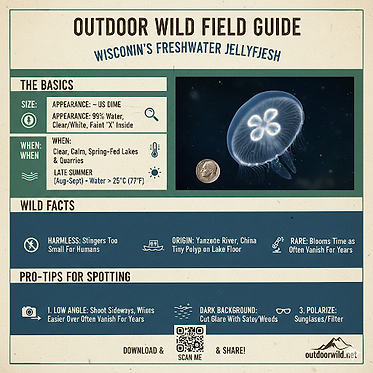
The Glass Mystery: Hunting Wisconsin's Freshwater Jellyfish
By the Outdoor Wild Team
Most people think of jellyfish as salty, ocean-dwelling hazards. But deep in the crystal-clear, spring-fed lakes of the Wisconsin Northwoods, a tiny ghost is hiding. It’s translucent, the size of a dime, and it only appears when the world is perfectly still.
Meet Craspedacusta sowerbii—the Wisconsin Freshwater Jellyfish.
Where to Spot Them
While they’ve been found in over 100 Wisconsin lakes (including massive spots like Lake Mendota), they are famous for appearing in the calm, northern spring-fed lakes and rock quarries of Vilas, Bayfield, and Florence counties.
They are masters of the "now you see me, now you don't" lifestyle. You can boat over the same spot for ten years and see nothing. Then, during a particularly hot August or September, the water temperature hits that magic 25^\circ\text{C} (77^\circ\text{F}) mark, and thousands of these tiny "medusae" bloom at once.
Wild Fact Sheet
The Size: Almost exactly the size of a U.S. dime.
The Look: 99% water and almost entirely clear. Look for a faint white "X" inside their bell.
The Sting: Non-existent for humans. While they have hundreds of microscopic stinging tentacles to catch plankton, they can’t pierce human skin. You can swim right through a "bloom" of them without feeling a thing.
The Origin: Known in China as the "Peach Blossom Fish," they likely hitched a ride to the U.S. in the early 1900s via ornamental water plants.
How to "Capture" One (On Camera)
If you're out on the water trying to document these for your own "Wild" journal, follow these pro tips:
Angle is Everything: Don't shoot straight down into the sun. Get your camera low to the water and shoot at an angle.
The Dark Secret: They are easiest to see against a dark background—look for them where the lake bottom drops off or over a patch of dark weeds.
Polarize: Use polarized sunglasses or a camera filter to cut the surface glare; otherwise, they’ll look like simple air bubbles.
Outdoor Wild Take:
These jellies are a reminder that "wild" doesn't always mean "big." Sometimes the most incredible encounters are the ones you have to squint to see.