The FalconTrail Page
The Trail Report & your Photo of The Month
My Story
My Lake of The Clouds Hiking Journey Story: Exploring the Porcupine Mountains Wilderness

Photographer
William Cannon
U.S. Geological Survey
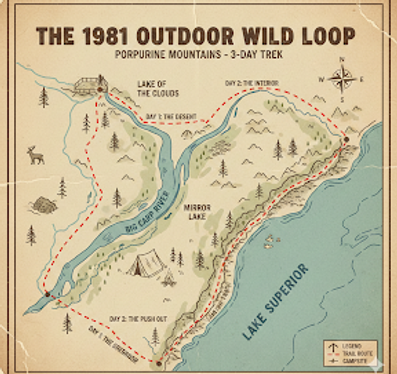
The Lake of the Clouds Journey: Exploring the "Porkies"
This is a story about a classic, rugged loop through the Porcupine Mountains Wilderness State Park—affectionately known as "The Porkies." Over the course of three days, the terrain shifts dramatically from high, windswept ridges down to the pristine shorelines of Lake Superior.
The Plan My cousin Art and I set out with a plan to hike deep into the backcountry and come out on the third day. It was a journey that required physical grit and careful planning, taking us through some of the most beautiful and breathless scenery in the Midwest. I was on a natural high just knowing I was trekking through a truly wild area, home to so many legendary wildlife species.
Day One: Heading In While we knew that crossing paths with wildlife is a rare privilege—most animals prefer to keep their distance from humans—the anticipation was part of the adventure. With our packs loaded with three days of provisions, we began our descent.
The Route Starting from the Lake of the Clouds overlook, we took the North Mirror Lake Trail. It’s one of the more demanding hikes in the park, dropping about 500 feet into the valley before climbing back up into the interior uplands. According to the park guides, it’s roughly 3.8 miles from the overlook to Mirror Lake, but in this terrain, every mile is earned
Day One: Camp at Mirror Lake
After descending from the overlook, we reached the shores of Mirror Lake to set up our first camp. By the time we dropped our packs, we had certainly earned our rest.
The Campsite Mirror Lake lived up to its name—the water was a perfect, glassy reflection of the surrounding ridges. We set up our gear as the evening air cooled down. There’s a specific kind of quiet you only find deep in the Porkies, miles away from the nearest road.
Provisions in the Wild
We fired up Art’s old-school Coleman stove for dinner. In those days, your meals were simple: freeze-dried pouches that you mixed with water. I remember we had a rice-based dish—hot, filling, and exactly what we needed after the elevation changes of the North Mirror Lake Trail. We filled our canteens, shared a meal in the fading light, and turned in early to prep for the big trek ahead.
Camp Life & Provisions
Cooking at Mirror Lake was a highlight of the day. We broke out our mess kits—those classic metal sets that served as our plates and bowls—to eat the rice and protein meals we’d prepared on the Coleman stove. Having a proper mess kit made a world of difference for keeping things organized in a small campsite. After dinner, we’d clean them with biodegradable soap and a little lake water, keeping our footprint small and our gear ready for the next morning.
The Big Carp River
The next morning, we would break camp and begin the long descent along the Big Carp River. This is where the trail truly enters the heart of the wilderness, following the water as it carves its way toward the greatest of the Great Lakes.
Day 2: Into the Heart of the Carp River Valley
The Descent
Leaving the stillness of Mirror Lake behind, we began the long descent toward the Big Carp River. This is where the trail truly enters the heart of the wilderness. The canopy of ancient towering pine trees that grew thicker, and the air turned cooler as we dropped in elevation.
As we followed the river’s path, the sound of rushing water became our constant companion. The Big Carp is a masterpiece of nature—it’s not just a river, but a series of waterfalls and rocky rapids that have carved through the bedrock over centuries. Every bend in the trail revealed a new vantage point of the water cascading over dark stones.
The Big Carp River Trail
The hiking here was more demanding. We were navigating over moss-covered roots and skirting the edges of steep ridges. Around mid-day, we found a perfect spot on a flat rock outcrop overlooking a series of small falls. It was the ideal place to take the packs off, rest our legs, and just listen.
In 1981, you didn't have GPS or cell service; it was just us, a map, and the realization that we were miles from the nearest road. There’s a certain kind of freedom that comes with knowing the only way out is to keep walking.
Looking Toward Superior
As the sun began to dip lower, casting long shadows through the forest, the river started to widen. We knew we were getting closer to the big water. Our goal for the evening was to find a spot where we could hear the distant roar of Lake Superior, marking the end of the valley and the beginning of the final stretch. But as it was getting later it was time to set up camp for one more evening
The Second Evening: Coffee and Beef Stew
As evening approached, we found a spot to set up our second camp along the river. The fatigue was real, but so was the reward. Art broke out his classic percolator and set it over the Coleman stove. Those small coffee pouches fit perfectly in the canister, and soon the smell of fresh coffee was cutting through the cool evening air—there’s nothing like it in the world.
For dinner, we had a hearty beef stew. Whether it was freeze-dried or from a can, it tasted like a five-star meal after a day on the trail. We sat there with our mess kits and warm coffee, recharging for the final push.
Day Three: The Shoreline and the Finish
On the third morning, the terrain began to level out as we approached the mouth of the Big Carp River. The woods finally opened up to the massive expanse of Lake Superior.
A Moment of Rest
Before making the final trek out, we stopped to rest by the big lake. It was a lot of hiking—miles and miles of rugged country—and we needed a moment to just sit and take it all in. Looking out over that water, you realize just how small you are in the face of the wild. As we rested we realized we were a little more tired than we thought . So we put our packs under our heads and took a quick power nap as they call it or forty winks it has been referred to. I woke up to Art talking in a low voice to a chipmunk standing on his leg eating a piece of bread he stole out of a loaf that
Art must have been munching on before he dosed off for a few moments. We both got a good laugh at that little guy enjoying his meal. He chewed through the plastic wrap bag and helped himself to a slice of bread . After the little chipmunk darted off of Art's leg Art put the bread back in his knapsack. We did not want to leave it out there for the wildlife because I read somewhere that bread is not actually good for little rodents and wild birds or ducks or whatever the case might be.
The Final Stretched
Refreshed by the lake breeze, we shouldered our packs for the last time. We hiked out along the shoreline, weary but fulfilled, completing our roughly 20-mile loop. We came out near the end of the park, leaving the "Porkies" behind, but carrying the grit and the memories of 1981 with us.
Total Distance : Approximately
20 miles of Wilderness
Artistic interpretation of Fred Bear. Created for Outdoor Wild.

The Ultimate Ultimatum: The Day the Legend Began The Fred Bear Story
In the early 1930s, Fred Bear was just another face at the Packard Motor Car Company in Detroit. But as the crisp October air rolled in, Fred felt a pull that no factory floor could satisfy: the hunting urge.
When he asked for time off for his annual deer camp, his supervisor didn’t just say no—he gave Fred a career-ending choice: "If you go, don't bother coming back".
For most men during the Great Depression, the choice was simple: stay and keep the paycheck. But Fred wasn't most men. He chose the woods, the canvas tents, and the quiet pursuit of the wild. He walked away from "security" and never looked back.
When the factory job vanished, a legacy was born. By 1933, Fred turned his "hobby" of crafting bows into the Bear Products Company.
That single act of defiance—choosing the wild over the cubicle—became the catalyst for the archery powerhouse we know today
.
At Outdoor Wild, we believe Fred had his priorities exactly right. Sometimes, the best thing you can do for your life is to get lost in the woods.
Dean Romano